
In New York City, the owner of the property next to a sidewalk is usually the one legally responsible for both repairing it and paying for injuries it causes. Two sections of the NYC Administrative Code split that responsibility. Section 19-152 makes owners pay to fix defective sidewalk flags. Section 7-210 makes owners liable in court when a pedestrian is hurt because the sidewalk was not kept reasonably safe.
The major exception covers one-, two- and three-family homes that are at least partly owner-occupied and used only as residences. For those properties, injury liability generally stays with the City. The owner still pays for most repairs, but not for damage caused solely by City street trees. Several other parties can also end up responsible, including utilities that own sidewalk hardware, tenants who created a defect, and contractors.
Section 19-152: The Owner's Duty to Repair
Administrative Code §19-152 is the repair statute. It lets the NYC Department of Transportation (DOT) order the owner of abutting property to install, repave, reconstruct or repair the sidewalk at the owner's own expense. DOT can only order repairs to flags (the individual concrete squares) that contain a "substantial defect."
What counts as a substantial defect
The statute lists nine categories:
- Missing flags, or a sidewalk that was never built.
- Cracks that let pieces of the flag loosen or be removed.
- Undermined flags sitting over a visible void, or loose flags that rock or seesaw.
- Trip hazards: a height difference between adjacent flags of half an inch or more, or a surface defect at least one inch across in every direction and at least half an inch deep.
- Improper slope, including flags that hold water or exceed cross-slope standards.
- Hardware or other fixtures not flush within half an inch of the sidewalk surface, and cellar doors that are unsafe or lack skid resistance.
- Certain structural cracks running between joints.
- Work that does not meet DOT sidewalk specifications.
- Patchwork, such as asphalt or other non-approved materials, or repairs that are not full depth.
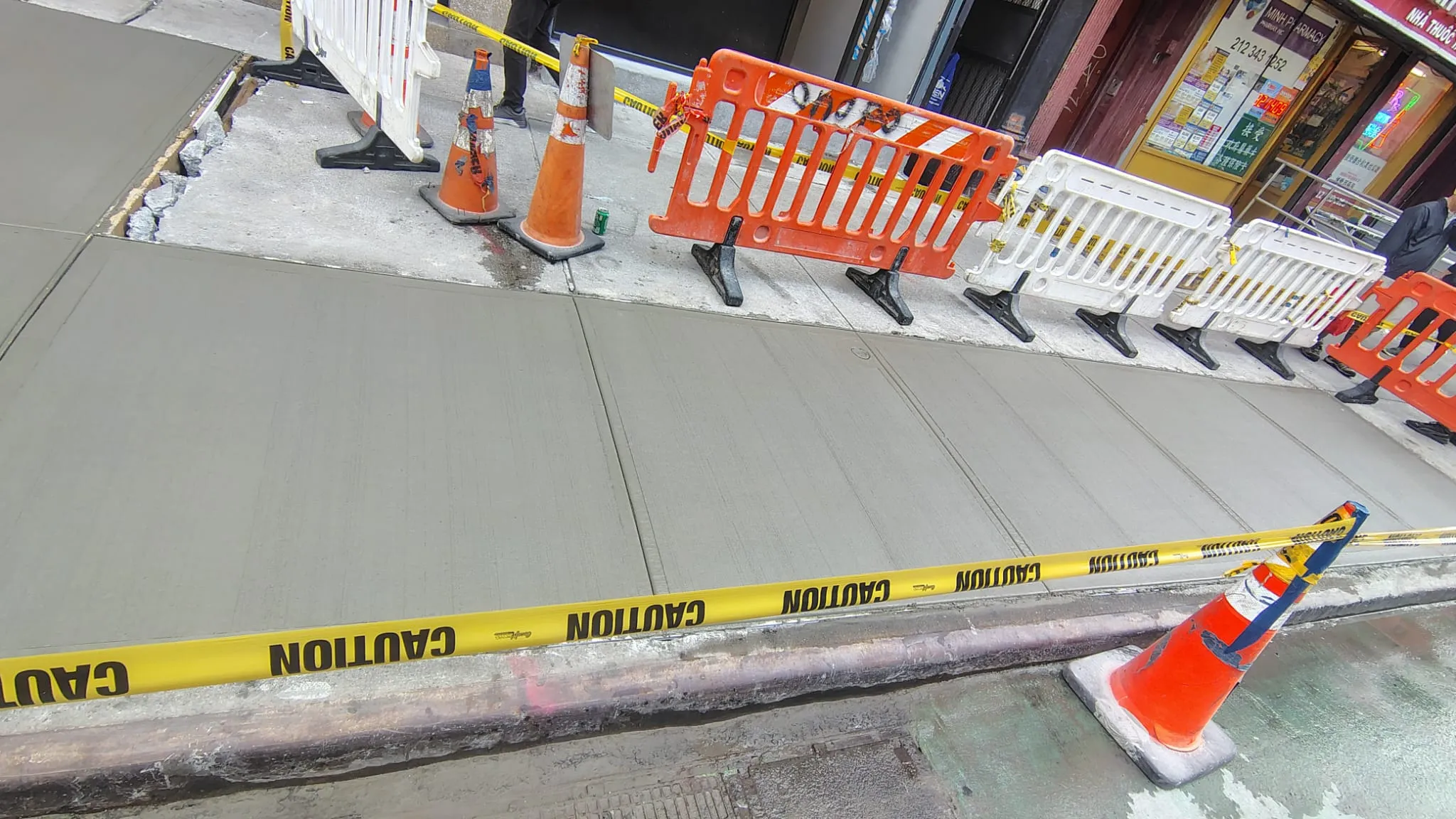
The last item matters in practice: a cheap asphalt patch over a broken flag can itself be cited as a defect. See our NYC DOT sidewalk repair standards guide for what a compliant repair looks like.
How enforcement works
DOT inspects sidewalks in response to complaints and issues a Notice of Sidewalk Violation when it finds a defect. There is no fine attached to a standard violation. A copy is filed with the County Clerk and stays on record until the City confirms the repair, which can complicate a sale or refinance.
The owner has at least 75 days from receiving the notice to make repairs. If DOT declares a condition an immediate danger, the window shrinks to 10 days. If the owner does nothing, DOT may do the work itself and bill the owner. Under the statute, the City can add administrative expenses of up to 20% of the cost, and an unpaid bill becomes a lien on the property. Owners of one- to six-family homes, or properties assessed at $30,000 or less, may pay bills between $250 and $5,000 in four annual installments.
Limits that protect owners
- City capital projects: DOT cannot order an owner to fix flags that the City or its contractors damaged during a City capital project.
- City tree damage at small homes: DOT does not issue violations to, or charge, owners of owner-occupied one-, two- and three-family homes not used commercially when the damage was caused solely by City trees, and it has cancelled liens that meet this standard. These homes may also qualify for a free repair through the NYC Parks Trees and Sidewalks Program.
- Reinspection: an owner who disagrees with a violation can request a reinspection through 311 within 75 days. DOT schedules it within 180 days, and a different inspector performs it without seeing the first inspector's report.
Section 19-152 by itself describes a repair obligation, not injury liability. That second piece comes from §7-210.
Section 7-210: Who Pays When Someone Gets Hurt
Section 7-210, often called the Sidewalk Law, took effect on September 14, 2003, as Local Law 49 of 2003. Before then, an abutting owner was generally liable only if it created the defect, made a special use of the sidewalk, or negligently repaired it. The City carried most of the risk.
Section 7-210 reversed that. It has three working parts:
- Duty (subd. a): the abutting owner must keep the sidewalk in a reasonably safe condition.
- Liability (subd. b): the owner is liable for personal injury, including death, and property damage proximately caused by failing to maintain the sidewalk. That includes failing to install, reconstruct, repave or repair defective flags and failing to remove snow, ice, dirt or other material.
- City immunity (subd. c): the City is not liable for injuries caused by failure to maintain sidewalks, except those next to the exempt small homes described below.
Courts describe the change plainly. In Khaimova v City of New York (2d Dept 2012), the Appellate Division said the law in effect shifted liability for sidewalk injuries from the City to the abutting owner.
Owners are not strictly liable
A fall on a broken sidewalk does not automatically make the owner pay. Section 7-210 does not impose strict liability, as the Second Department held in Nisimova v City of New York (2016). The injured person still has to prove ordinary negligence, which means showing the owner either:
- created the defect, or
- had actual or constructive notice of it long enough to discover and fix it.
Constructive notice requires a defect that was visible and apparent and that existed long enough before the accident for the owner to find and remedy it, a standard repeated in Gomez v NA Broadway Realty (2d Dept 2025). Photographs of a long-standing raised flag, an open DOT violation, or a prior complaint are typical evidence. In Harakidas v City of New York (2d Dept 2011), testimony that a commercial owner regularly inspected its property was enough to raise a question of actual notice of a defect that had existed for more than two years.
The trivial defect defense
Owners also frequently argue that a defect was too minor to be actionable. New York has no bright-line height rule for this. In Hutchinson v Sheridan Hill House Corp. (2015), the Court of Appeals held that courts must weigh all the facts, including the defect's width, depth, elevation, irregularity and appearance, plus the time, place and circumstances of the fall. A small defect can still support a claim if surrounding conditions made it a trap.
Repair standard, not a liability line: the half-inch threshold in §19-152 tells DOT when to cite a flag. A defect under half an inch can still lead to liability, and one over half an inch may still be found trivial in context.
Tree wells are not part of the sidewalk
Section 7-210 does not make owners liable for injuries in a City-owned tree well. Courts treat the tree well, including its perimeter, as the City's responsibility, so a fall inside or on the edge of a tree well generally does not fall on the abutting owner. The concrete flags around the tree well remain the owner's responsibility.
The Owner-Occupied 1-3 Family Home Exemption
Section 7-210's liability shift does not apply to "one-, two- or three-family residential real property" that is (i) in whole or in part owner-occupied and (ii) used exclusively for residential purposes. All three conditions must be met at the time of the accident. The Council's stated reason, quoted in Aracena v City of New York (2d Dept 2016), was that small resident owners with limited resources should not carry exclusive liability for sidewalk upkeep.
How courts have applied each condition:
- Number of units. Courts look at how the building is actually configured and used, not only its legal classification. A building with a fourth residential unit, even an unlawful one, can lose the exemption.
- Owner occupancy. Partial occupancy is enough. In Lai-Hor Ng Yiu v Crevatas (2011), a life tenant living in the house counted as an owner, so the exemption applied even though the defendant trustee lived elsewhere. Deposition testimony that the owner actually lived elsewhere can create a question of fact that sends the issue to a jury.
- Exclusively residential use. A ground-floor shop, a home office open to clients or a rented commercial space can defeat the exemption.
- Corporate owners. The exemption can apply to owners that are corporate entities if the property otherwise qualifies, as noted in Prete v JJ Hoyt LLC (2024).
The owner seeking the exemption has to prove it, typically with deeds, Department of Finance records, certificates of occupancy, and testimony about who lived there.
What the exemption does and doesn't do
The exemption shields a qualifying owner from tort liability under §7-210. It does not erase every obligation:
- The owner still has the §19-152 repair duty for most defects and can be billed by DOT. The one exception: DOT does not issue violations or charge these owners for damage caused solely by City trees.
- The owner can still be liable under ordinary common-law principles if it created the defect, negligently repaired the sidewalk, or made a special use of it, such as a private driveway apron.
- Liability for the sidewalk itself shifts back to the City, but only subject to the City's own defenses, covered next.
When the City of New York Is Liable
The City remains a possible defendant in a narrower set of cases:
- Sidewalks next to exempt 1-3 family homes. This is the main category.
- Sidewalks next to City-owned property, such as City buildings and some park frontage.
- Falls inside or on the edge of a City-owned tree well.
- Defects the City itself created, for example through negligent work by a City agency.
The prior written notice rule
Even in those cases, the City has a strong defense. Under Administrative Code §7-201(c)(2), the City cannot be sued over a defective sidewalk unless it received prior written notice of the specific defect and failed to fix it within a reasonable time, or unless the City affirmatively created the defect. In practice, written notice often comes from maps filed by Big Apple Pothole and Sidewalk Protection, from 311 complaints or from DOT's own records. Many claims against the City fail on this point alone.
Not liable for non-exempt property, even when City trees cause the damage
A common misconception is that the City must pay whenever a City street tree lifts a sidewalk. For non-exempt properties, courts have rejected that. In Engley v 639 Jefferson Place, LLC (1st Dept 2025), the Appellate Division dismissed the claim against the City because the abutting property was not an owner-occupied residence, even assuming City-planted trees caused the defect. The owner of the commercial or multifamily building remained the defendant.
The picture is different for small homes. Through the Trees and Sidewalks Program, NYC Parks performs free repairs for qualifying sidewalks severely damaged by curbside tree roots, but only in front of 1-, 2- and 3-family homes. Sites are inspected and ranked, so repairs are not immediate. Read more in our guide to sidewalks damaged by tree roots.
Other Parties Who Can Be Liable
Several other parties can also be liable, depending on who owns the hardware, who created the defect, and what the lease says.
Tenants and leases
The §7-210 duty belongs to the owner and is nondelegable. In Xiang Fu He v Troon Management (2019), the Court of Appeals held that an owner can hand the work of sidewalk maintenance to someone else but cannot shift the duty or the liability that comes with it. A triple-net lease that makes the tenant responsible for the sidewalk does not get the owner out of a lawsuit, although the owner may seek indemnification from the tenant under the lease.
A commercial tenant is generally not liable to the injured person under §7-210. Courts allow tenant liability in three situations:
- The tenant created the defect.
- The tenant made a special use of the sidewalk for its own benefit, such as a vault, ramp, or loading area.
- The lease is so comprehensive and exclusive that it entirely displaces the owner's duty to maintain the sidewalk.
Utilities and owners of sidewalk hardware
Under DOT's highway rules, 34 RCNY §2-07(b), the owner of a cover or grating in the street or sidewalk is responsible for monitoring and repairing it and the area extending 12 inches out from its perimeter. That includes manhole covers, transformer vault covers, gratings and curb valves owned by utilities, the MTA or City agencies.
If a pedestrian trips within that 12-inch zone, the hardware owner may be liable instead of, or alongside, the abutting owner. In Storper v Kobe Club (1st Dept 2010), the court held that §7-210 does not override this rule or let a plaintiff shift the MTA's obligation onto the building owner. Abutting owners are responsible only for hardware that belongs to their own property, such as their cellar doors.
DOT also advises that when a utility or contractor damages a sidewalk, the property owner should document the damage and seek repair from the company that caused it. DOT's permit search can help identify who worked at an address.
Contractors
A contractor that negligently performs sidewalk or street work can be liable for a defect it creates, regardless of who owns the abutting property. Permit holders also carry a three-year responsibility for restoring street openings under DOT's rules, and courts have held that this guarantee period does not limit liability for affirmative negligence, as in Shehata v City of New York (2d Dept 2015).
Quick Reference: Who Is Likely Responsible
The table below summarizes the default rules. The facts of a specific case, especially notice, can change the outcome.
| Situation | Who pays to repair | Who is usually liable for injuries |
|---|---|---|
| Commercial, mixed-use or 4+ unit building | Owner (§19-152) | Owner (§7-210), if it created the defect or had notice |
| 1-3 family home, owner-occupied, residential only | Owner (§19-152), except damage caused solely by City trees: no violation or charge, and free Parks repair possible | City, but only with prior written notice or if the City created the defect |
| 1-3 family home that is not owner-occupied, or has a business use | Owner | Owner (§7-210) |
| Defect caused by a City street tree, non-exempt building | Owner | Owner (City not liable, per Engley) |
| Fall inside or on the edge of a City tree well | City | City, subject to §7-201 notice rules |
| Defect within 12 inches of a manhole, grate or utility cover | Hardware owner | Hardware owner (34 RCNY §2-07), possibly alongside the abutting owner |
| Defect created by a tenant or tenant's special use | Owner, with possible lease indemnity | Owner and the tenant |
| Defect created by a contractor or utility excavation | Party that did the work | That party, possibly alongside the owner |
| Snow or ice, non-exempt building | Owner, tenant or occupant must clear (§16-123) | Owner (§7-210) |
| City-owned property | City | City, subject to §7-201 notice rules |
What Property Owners Should Do
Since §7-210 liability turns on notice, the strongest protection is fixing defects before someone falls.
- Inspect regularly. Walk the frontage and look for the §19-152 conditions above, especially raised flags of half an inch or more, rocking flags and asphalt patches. DOT encourages owners to repair before a defect results in a violation.
- Check for open violations. You can request the status or a copy of a sidewalk violation through NYC311, or look it up by address or BBL. An open violation is strong evidence of notice in an injury case.
- Repair correctly. Use a licensed contractor with a DOT sidewalk construction permit and full-depth concrete. After the work, request a dismissal inspection so the violation is cleared from the record.
- Identify other responsible parties. If the damage sits within 12 inches of utility hardware, or was caused by a contractor or a City street tree, document it and contact the responsible company, agency or the Parks Trees and Sidewalks Program.
- Review insurance and leases. Non-exempt owners should confirm that their liability policy covers the abutting sidewalk, and commercial owners should check that leases include sidewalk maintenance, indemnification, and additional insured provisions. These clauses do not remove the owner's duty but can shift the cost.
- Keep records. Dated photographs, repair invoices, permits, and snow-removal logs help show reasonable care if a claim arrives years later.
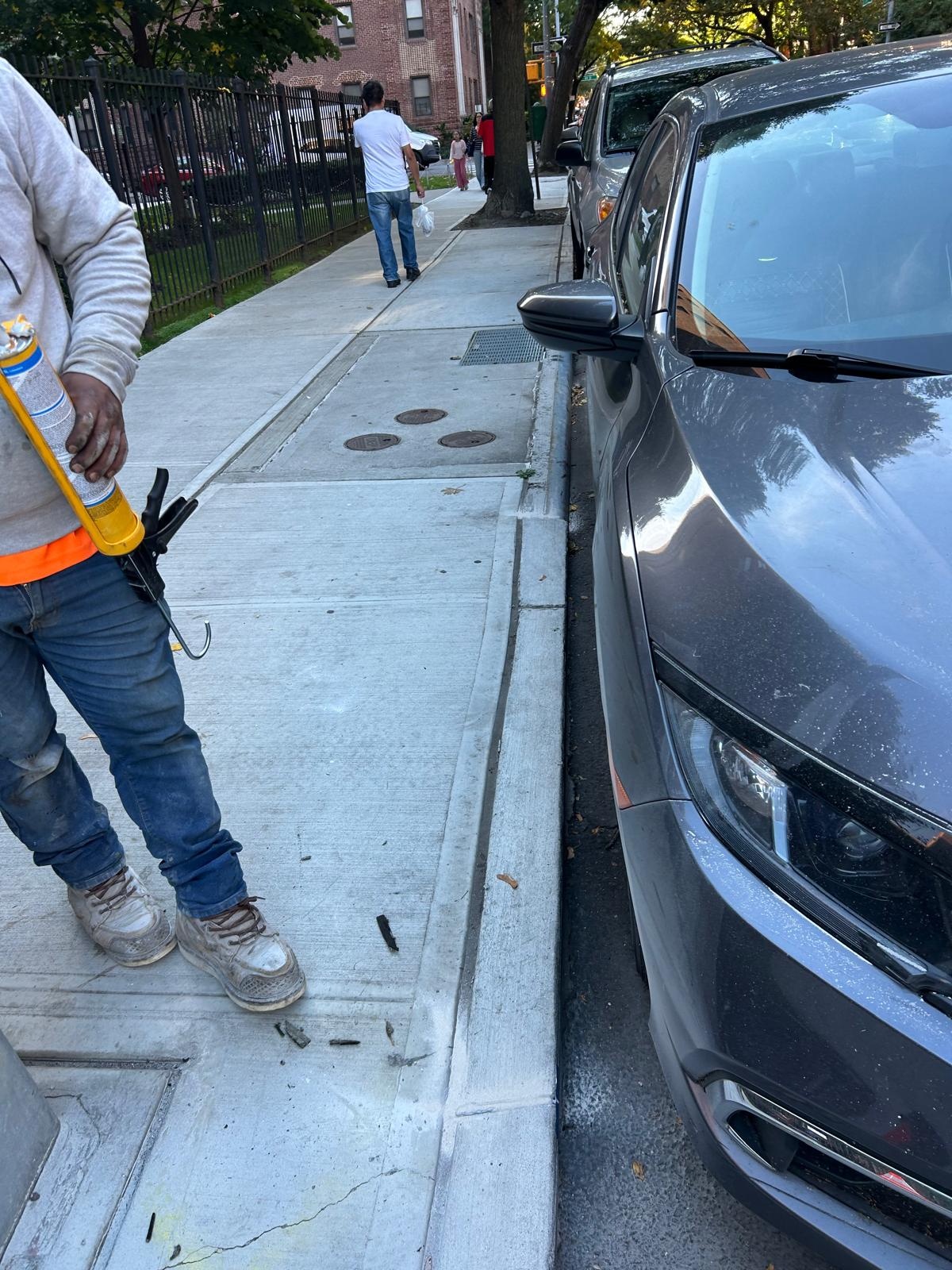
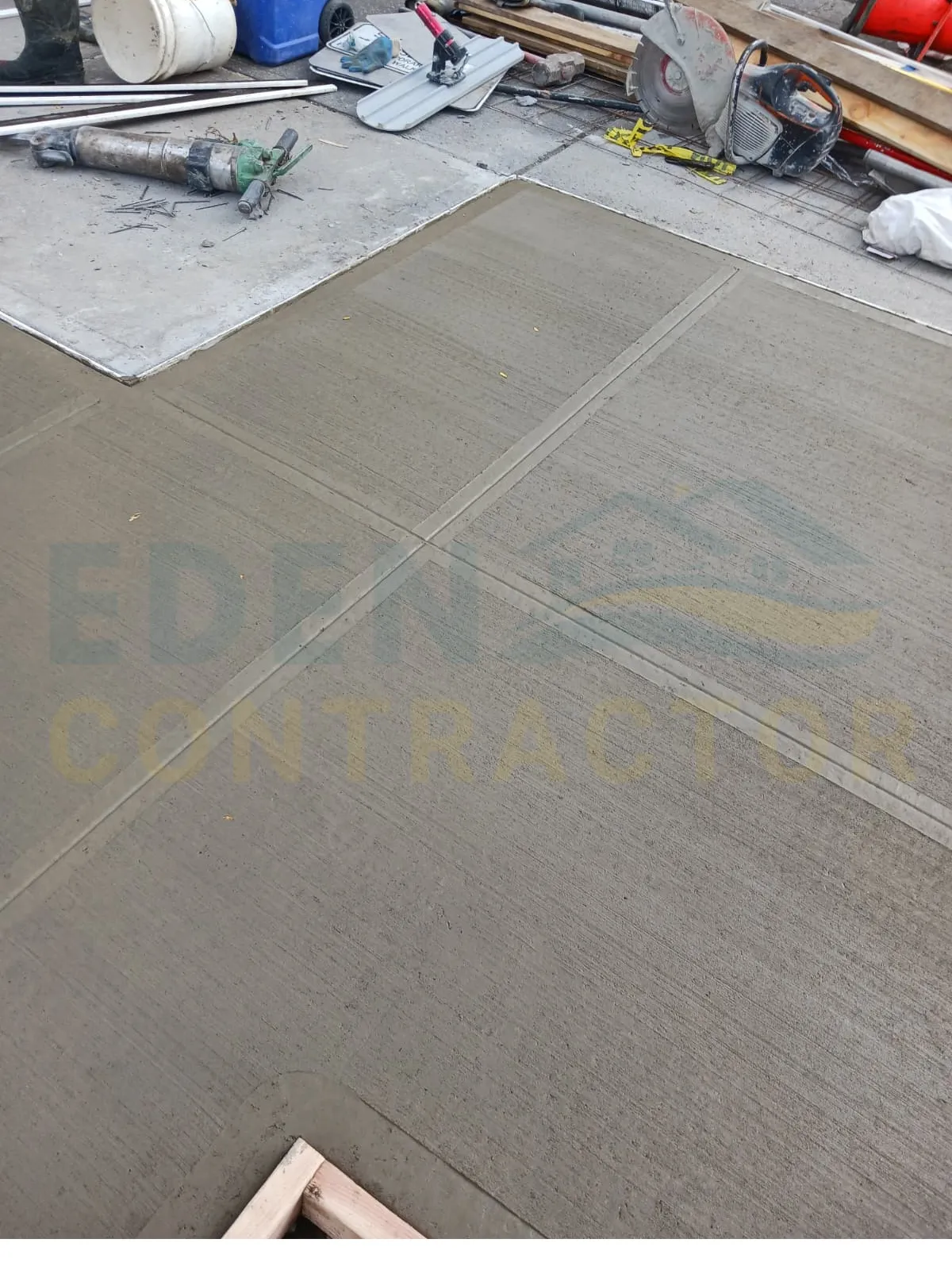
Protect your property and reduce liability risk with timely, DOT-compliant sidewalk repairs. We inspect your frontage, explain what the law requires for your property type, and give you a free written estimate.
📞 Call 917-624-8550Sources
- NYC Administrative Code §19-152
- NYC DOT: Sidewalk repair and violations
- NYC Department of Finance: Sidewalk repair charge installment application
- NYC Parks: Trees and Sidewalks Program
- Hutchinson v Sheridan Hill House Corp., 26 NY3d 66 (2015)
- Xiang Fu He v Troon Mgt., Inc., 34 NY3d 167 (2019)
- Engley v 639 Jefferson Place, LLC, 240 AD3d 407 (1st Dept 2025)
- Storper v Kobe Club, 76 AD3d 426 (1st Dept 2010)
This article is general information about NYC sidewalk rules, not legal advice. Liability depends on the facts of each case. If you have been sued or received a claim, consult a New York attorney.